Monju, the holy one, first opened this path. Kōbō of Kongo then revived it. Without male and female, its pleasures are like an endless circle. Men shout with pleasure when they attain entrance.
(Ikkyu, 1394-1481)
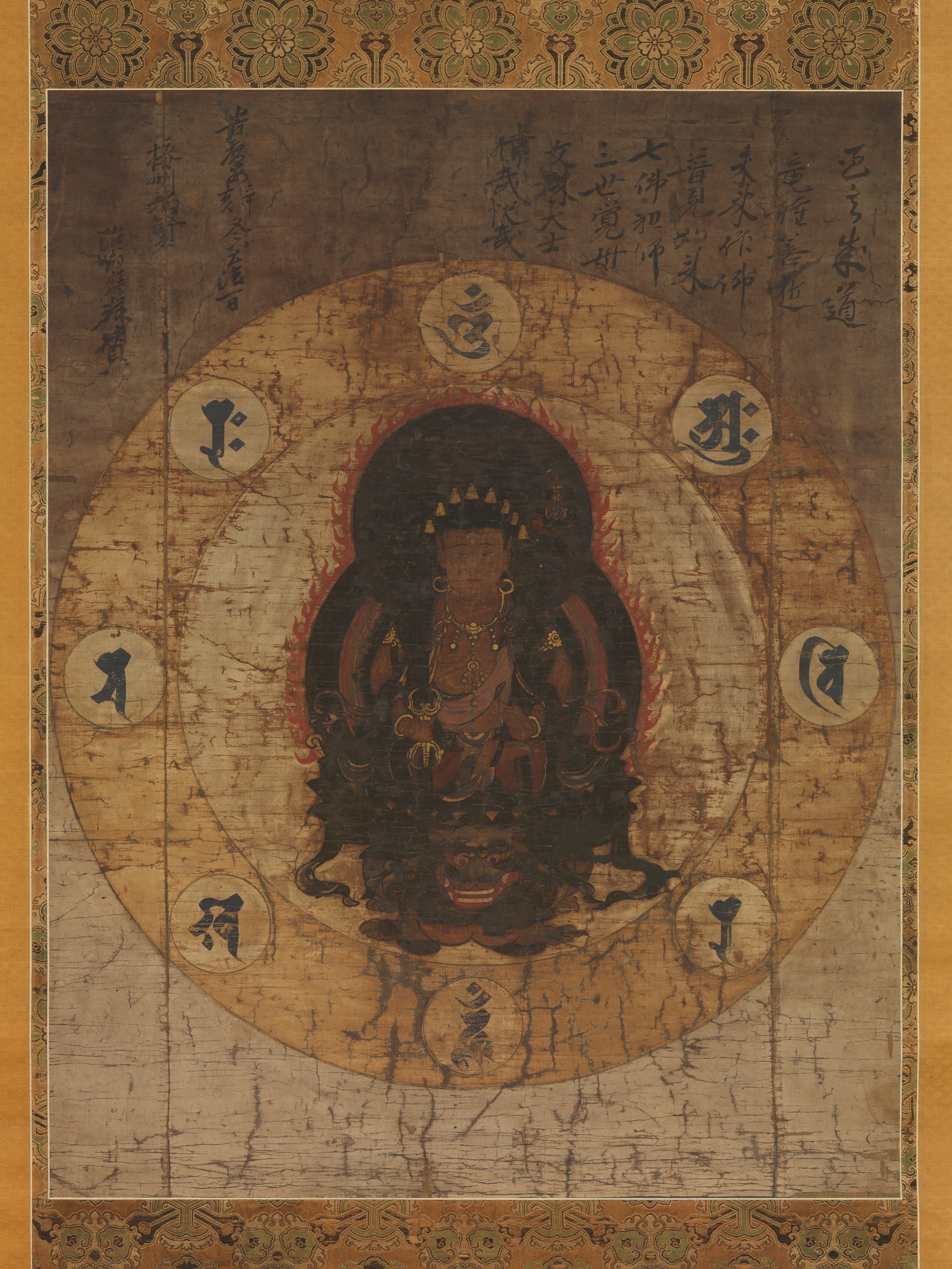
Nanbokuchō period (1336–1392), Japan
Hanging scroll, ink and color on silk, courtesy of The MET
The aristocratic monk Kūkai is the stuff of legend and ranks among one of the divine beings (kamisama) who protect Japan. He brought Shingon (真言), True Word, to Japan after he accompanied an Imperial Mission to China (804-806 CE).
In 805, Kūkai met the master Hui-ko (764-805 CE), from whom he received dharma transmission. Once Kūkai returned to Japan he gained an immense following among the Heian aristocrats. In 816, he founded the famous temple complex on Mount Koya (高野山). In 835, just before his death, Kūkai opened a temple in the private quarters of the Imperial Family (Inner Palace) in Kyoto under Emperor Nimmyo.
In 921, the Emperor conferred on Kūkai the title Kobo Daishi (弘法大師), Great Teacher Transmitting Dharma, in recognition of his contributions to Japanese culture and his immense spiritual influence.
Kōbō Daishi’s Book
Kōbō Daishi Ikkan no Sho, written in 1598, claims that Kōbō Daishi appeared to a lay worshipper, promised to reveal Shingon’s secret teachings on the love of boys and produced this book.
Part One describes ten hand positions (mudra) used by young acolytes to communicate their feelings to monks. Part Two teaches monks seven ways to determine an acolyte’s readiness for lovemaking. Part Three describes methods of anal sex.
Part One
1) If an acolyte clenches his fingers, from the index finger to the little finger, it means, “You are the only one I love.”
2) If an acolyte clenches both hands completely except for one thumb, it means, “I acknowledge your love and will make myself yours to do with as you please.”
3) If an acolyte touches the index and middle finger to his thumb, it means he wants to see you.
4) If an acolyte flips the tassel of his fan, it is an invitation to visit.
5) If an acolyte forms the a circle with the index finger and thumb on both hands, it means, “Tonight.” If he uses the middle finger, it means, “Tomorrow night.” And if he uses the ring finger, it means, “Some other time.”

Part Two
1) After an acolyte has spoken, observe him carefully. The acolyte who speaks quietly is sensitive to love. To such a boy, show your sincerity by being somewhat shy. Make your interest in him clear by leaning against his lap. When you remove his robes, calm him by explaining exactly what you will be doing.
White snow on a mountain peak turns to pure water on the rocks and finally flows down.
As the poem illustrates, snow on even the highest mountain peak is destined to melt and flow downward. Likewise, no matter how lacking in sensitivity to the mysteries of love an acolyte may be, he can be made yours if you approach him right.
Part Three
1) There is a method called skylark rising. The ass is raised in the air like a skylark rising in the sky. Insertion is painless.
2) Always keep “cut plums” on hand in case you want to attempt insertion without saliva.
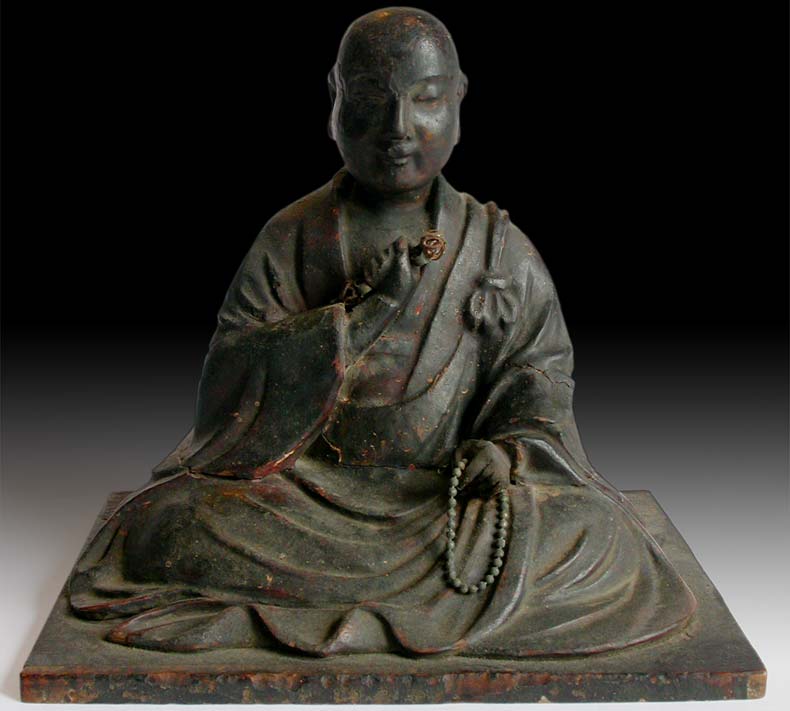
Hollow core wood carving, with red pigment and black lacquer.
Sources
Schalow P. (1992) Kukai and the Tradition of Male Love in Japanese Buddhism, Buddhism, Sexuality, and Gender. J. Cabezon ed. NY: SUNY Press.

 Epistemic Instruments