India’s goddess Maya (Illusion), the elemental power of the cosmos who controls the movements of space and time, fascinated Ralph Waldo Emerson and eventually helped him cope with the loss of his beloved wife, Ellen Tucker, to tuberculosis in 1831.
Emerson likely became aware of Maya after reading Charles Grant’s Poem on the Restoration of Learning in the East (1807). Grant supposed Maya to be a “Goddess sprung from Brahma.” This is not wrong. Maya is the visible diversity of the cosmos, or nature, that clothes its unity: the One, Brahman. She is often referred to as the “veil of illusion.”
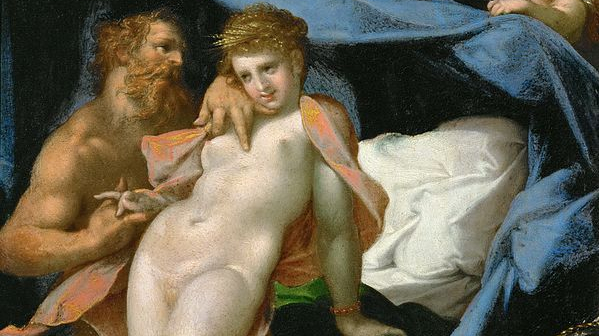
Emerson, who loved the Greeks, noted a relation between Grant’s Maya and the Greek Pallas Athena, goddess of Wisdom, Arts and War, who sprang from Zeus’s head fully formed in battle armour. There is a well known myth from the Roman poet Ovid about a weaving competition between Athena and Arachne, a mortal girl. Arachne weaves a cheeky tapestry mocking the gods, yet her skill matches that of Athena. This infuriates the goddess and she beats the girl, who then commits suicide and is transformed into a spider.
In Maia, Emerson uses this myth of Athena and Arachne to amplify the relation between Western and Indian mythology that he saw in Grant’s poem and to refashion images of both the Greek Maia, one of the seven Pleiades who gave birth to Hermes, messenger of the gods, after she was raped by Zeus, and the Roman Maia, who is mother earth.
According to Emerson, Bishop Berkely’s idealism brought him to see that “there was a cause behind every stump and clod” which made the material world “oscillate a little and threaten to dance.” In his studies of Indian spirituality, Emerson found the cosmic dance of Puruṣa (soul) and Prakṛti (nature) within the ancient dualist metaphysics of the Samkhya-Yoga school (darśana). Emerson believed that this Indian vision (darśana) of Puruṣa–Prakṛti was equal to Kant’s vision of the Sublime, “the Idealist terror and beauty, life and light.”
This is the image that Emerson ultimately crafted in Maia.
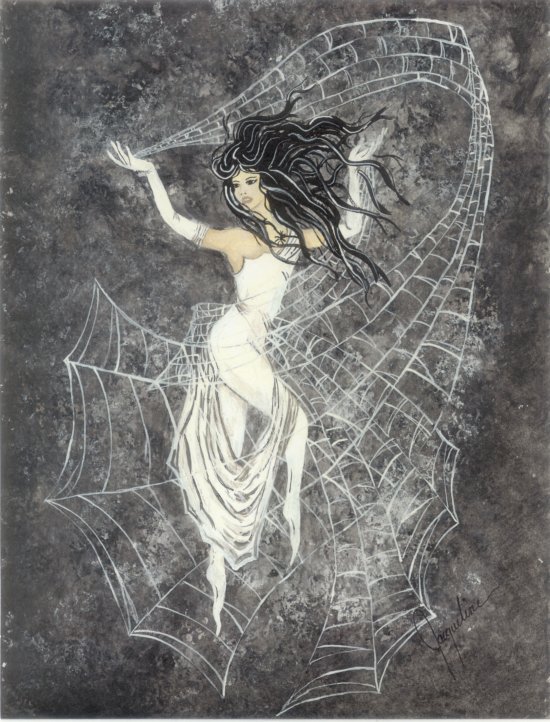
Illusion works impenetrable
Weaving webs innumerable.
Her gay pictures never fail
Crowds each on other, veil on veil.
Charmer who will be believed
By man who thirsts to be deceived.
Illusions like the tints of pearl
Or changing colors of the sky
Or ribbons of a dancing girl
That mend her beauty to the eye.
The cold gray, down upon the quinces lieth
And the poor spinners weave their webs thereon
To share the sunshine that so spicy is.
Samson stark at Dagon’s knee
Gropes for columns strong as he;
When his ringlets grew and curled,
Groped for axle of the world.
But Nature whistled with all her winds,
Did as she pleased and went her way.

 Epistemic Instruments